
Barker Mediation
Family Mediation Services
Professional Family Mediation
Professional Family Mediation
When family relationships become strained and conversations feel impossible, professional mediation creates a structured, respectful space where people can speak freely, listen attentively, and begin working toward practical agreements.
Mediation is not about winning or losing, nor about determining who is correct and who is not. It creates the conditions for families to discuss matters constructively and make informed decisions about their future — together.

Family life can be precious and filled with meaning — but it can also become complicated. When relationships shift or disagreements grow difficult to resolve, communication often breaks down. Emotions run high, and conversations that once felt natural may begin to feel completely out of reach.
Barker Family Mediation provides a mindful, structured alternative. Rather than allowing interactions to become driven by blame or confrontation, the mediation process is oriented towards understanding, and towards collaborative discussion within a genuinely respectful environment. The aim is always the same: to help families move forward from conflict toward clarity, stability, and workable real-life agreements.
Every family situation is unique. Every relationship carries its own history and its own emotional weight. Barker Family Mediation appreciates that complexity, approaching each case with patience and sensitivity, recognising that what feels manageable for one family may feel insurmountable for another.
For many families, mediation represents a significant shift from other methods of resolving disputes. It is not adversarial in nature. It does not determine winners or assign fault. Instead, mediation creates the space for genuine conversation — so families can make thoughtful decisions about their future, together.
Mediation does not seek to assess past decisions or re-litigate moments of conflict. The conversation is gradually redirected toward understanding the current landscape and identifying practical steps that will be of genuine use in the future.
Left unaddressed, even minor family disagreements can become entrenched over time. Professional mediation provides the structure and impartiality needed to interrupt that cycle and create space for meaningful progress.
Mediation provides a calm, professionally structured setting that is free from the pressures of confrontational interaction, allowing all parties to feel genuinely safe to speak.
An independent mediator ensures discussions remain balanced. No single perspective is favoured, and all voices are given the time and space needed to be heard and considered properly.
Solutions are not imposed from the outside. Families retain control over the decisions that affect their lives, making resulting agreements far more likely to feel fair and to be sustained.
Mediation actively works to preserve ongoing relationships that must continue — particularly important when children are involved and co-parenting cooperation is essential.
Discussions take place in a confidential setting. Families are able to share their concerns and priorities openly, without those conversations being subject to outside scrutiny.
Rather than dwelling on historical grievances, mediation deliberately redirects conversations toward practical decisions and a forward-looking perspective that genuinely benefits families.
One reason mediation feels accessible to many families is that the process itself is clear and predictable. Each stage is designed to support calm conversation and deliberate decision-making, ensuring that no one feels rushed or pressured at any point.
Sessions progress at a pace that feels natural and manageable. Families are encouraged to explore ideas openly, revise assumptions, and consider arrangements collaboratively until they land on solutions that feel equitable and workable in daily life.
The aim of mediation extends beyond resolving a single disagreement. It is also to equip families with communication practices that will support them long after the formal sessions have concluded.
The mediator begins by explaining how the process works, what participants can expect, and answering any initial questions. This establishes clarity and helps put everyone at ease from the outset.
Each person is given the opportunity to explain their perspective and what they hope to achieve. There is no interruption, and no judgement. The emphasis is on being heard and hearing others fully.
The mediator facilitates respectful dialogue, keeping conversations focused and productive. When discussions become heated or lose clarity, the mediator gently steers them back toward progress.
Families begin exploring the ideas and arrangements that feel workable. These might cover parenting plans, communication methods, shared responsibilities, or day-to-day logistics.
Decisions are recorded in a clear and structured way so that all parties have a shared, transparent understanding of the outcomes and what has been agreed upon going forward.

There is no single type of family for whom mediation is appropriate. The process is flexible and sensitive enough to support a wide range of circumstances, from relatively straightforward practical disputes to more complex emotional situations where communication has been strained over a long period of time.
Separating or separated couples who need to navigate practical decisions around living arrangements, responsibilities and future planning in a calm, supported environment.
Parents navigating co-parenting arrangements, who wish to establish clear, child-focused routines and communication frameworks that provide continuity and reassurance for their children.
Families experiencing communication difficulties, where conversations have become consistently difficult or where important topics have begun to be avoided altogether.
Families managing significant life transitions, such as changes in living arrangements, shifting household responsibilities, or new financial realities that require honest, structured discussion.
Parents concerned about the wellbeing of their children, who recognise that reducing conflict and improving communication between adults directly supports children's sense of stability and security.
Families who prefer a private, collaborative process and who wish to retain control over decisions rather than having arrangements determined by external parties.
Family disagreements rarely appear suddenly. In most cases, they form gradually over time. Small differences of opinion, changes in routine, or unexpected life events can quietly apply pressure on relationships. What begins as a manageable misunderstanding can become far more difficult to navigate when emotions begin to take hold and conversations grow increasingly strained.
Separation is one of the circumstances that places the greatest emotional pressure on families. When a relationship shifts, both parties often carry a great many unresolved questions about what happens next. Decisions regarding living arrangements, parenting responsibilities, daily routines and long-term plans all require discussion at a time when emotions may still be running high.
Financial tension can compound these difficulties. New financial realities and changes in living situations may require approaches that neither party has previously considered. Without a calm and structured framework for these discussions, financial matters can quickly become an additional source of conflict rather than a practical problem to be solved together.
Parenting arrangements present their own set of challenges. Parents may share the same fundamental goal — to support their children through a period of change — yet the path toward that goal can involve genuinely complicated decisions. Establishing consistent schedules, maintaining routines, and ensuring children feel equally supported by both parents requires careful planning and thoughtful communication.
Children themselves are sensitive to the emotional atmosphere around them, even when adults work hard to shield them from conflict. Changes in routine or emotional tension between adults can raise confusion and anxiety in younger family members. Parents frequently recognise this and understand that seeking to reduce conflict is, in itself, an active step toward protecting their children's wellbeing.
What most people in conflict situations genuinely want is relatively simple: to feel heard, to have their concerns acknowledged, and to be treated with respect. Mediation is designed specifically to create the conditions for that to happen.

"Mediation does not ask anyone to let go of what is important or give up on their principles. It simply creates a space where those viewpoints can be expressed and processed in a healthy, constructive manner."
Barker Family Mediation provides a neutral, calm, and professionally structured environment in which difficult conversations can take place more comfortably. The setting is deliberately low-key, designed to encourage thoughtful discussion rather than reactive exchanges. Rather than speaking over one another, participants are given the space to articulate their views carefully and with respect.
An impartial mediator facilitates the discussion to ensure all voices are considered. This role is not about judging the situation or determining who is right or wrong. The mediator holds space for the conversation itself, maintaining balance by allowing each person to speak freely and openly without interruption or external pressure.
For many families, this simple structural change makes a significant difference. When people know they will have time to properly explain their concerns, they often feel more willing to engage openly and listen more attentively to others in turn.
As mediation progresses, conversations often shift in tone. Issues that once felt overwhelming begin to feel more manageable. When given the opportunity to express concerns clearly and hear those of others, families frequently find that they share more common ground than previous confrontational conversations had allowed them to recognise.
The mediator also supports realistic thinking throughout this stage. While everyone naturally wants the best possible outcome, mediation helps families focus on what will genuinely work in practice — solutions rooted in the actual responsibilities, schedules and commitments of those involved.
Over time, participants often come to understand that conversations do not have to result in conflict. It becomes possible to hold a different viewpoint from someone and still treat them — and be treated — with respect.
One of the most meaningful aspects of mediation is that the people most directly affected by the outcome are the ones who shape it. Rather than having decisions imposed upon them, families work together to identify arrangements that reflect their genuine needs, their priorities, and the realities of their daily lives.
This sense of ownership and participation frequently results in stronger, more sustainable agreements. When people have actively contributed to a decision, they are considerably more likely to regard the outcome as fair and to uphold it over time. Arrangements that feel jointly created, rather than externally imposed, carry a different quality of commitment.
Practical agreements in mediation are rarely about finding a perfect solution. They are about identifying what is manageable and sustainable for everyone involved. Families consider the needs of children, the responsibilities of each parent, and the realities of daily life — producing arrangements that limit uncertainty and create clear, shared expectations.
Perhaps equally importantly, families who engage in mediation often develop communication skills that extend well beyond the formal sessions. The experience of discussing sensitive issues in a calm, structured environment can reset patterns of interaction, making future conversations considerably more constructive.
The integrity of the mediation process depends entirely on the environment in which it takes place. Barker Family Mediation is committed to ensuring that environment is consistently safe, respectful, and carefully maintained.
The mediator does not represent either party, does not form or express personal judgements, and does not advocate for any particular outcome. Their sole purpose is to maintain the fairness and balance of the discussion throughout.
If discussions become heated or emotionally charged, the mediator intervenes constructively to restore calm and refocus the conversation. No one is permitted to feel unsafe, pressured or marginalised during any part of the process.
All conversations within mediation sessions are treated as strictly confidential. Participants can speak openly, knowing their words will not be used against them in other settings or shared with parties outside of the process.
Participation in mediation is entirely voluntary. No one is pressured to agree to arrangements they are not comfortable with. The process respects each participant's autonomy and ensures that all agreements reflect genuine, uncoerced consent.
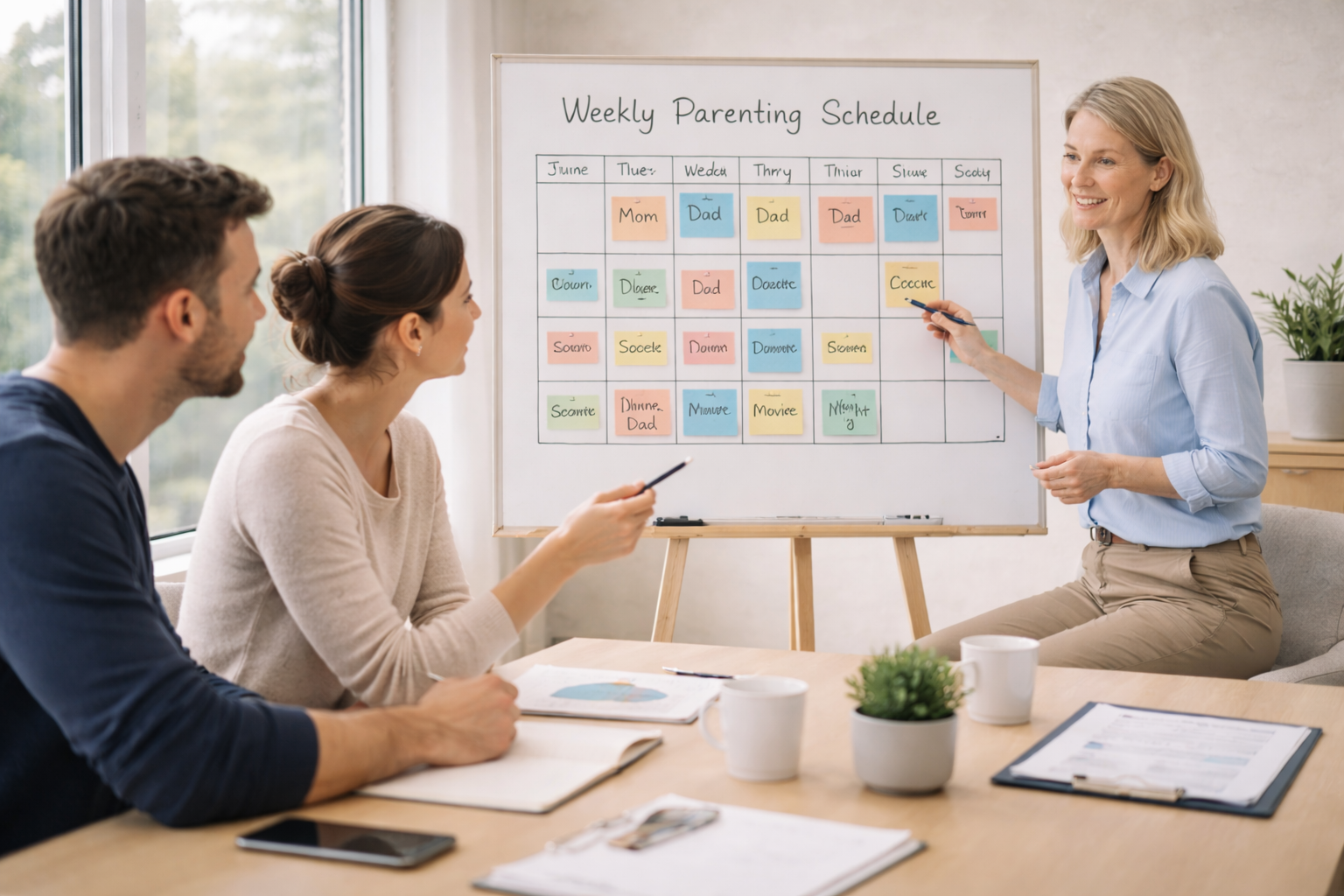
The benefits of mediation are not limited to what is agreed upon within the formal sessions themselves. Many families find that the communication skills and habits developed during the process have a lasting, positive impact on how they interact going forward.
By learning how to approach sensitive topics in a calm, structured environment, families acquire tools that prove useful in future conversations — including those that arise long after the mediation process has formally concluded. These skills help prevent new disputes from escalating and support a more constructive relationship between those involved.
Agreed arrangements are recorded clearly at the conclusion of sessions. This clarity provides a shared reference point and limits the potential for misunderstanding or disagreement about what was decided. For many families, this documented clarity alone provides a significant sense of relief.
Mediation also encourages ongoing collaboration between those who will continue to need to communicate — particularly important in co-parenting situations where consistent, respectful dialogue directly benefits the children involved.
When communication channels remain open and grounded in the cooperative principles established through mediation, families are far better positioned to manage future challenges without returning to adversarial patterns.
For many families, mediation represents not just a resolution to a specific conflict, but the beginning of a genuinely different way of communicating — one that continues to deliver benefits long after sessions have ended.
What is family mediation and how does it differ from other approaches?
Family mediation is a professionally guided process in which an impartial facilitator supports families in discussing disagreements and working toward practical solutions collaboratively. Unlike legal proceedings or arbitration, mediation is not adversarial — no one wins or loses. Instead, the process is focused on communication, understanding and the creation of arrangements that work for everyone involved.
Is mediation appropriate if communication has already broken down significantly?
Yes. In fact, many families arrive at mediation precisely because communication has become very difficult or has stopped altogether. The structured environment of mediation is specifically designed to support conversations that feel impossible in unguided settings. The presence of an impartial mediator creates conditions that allow people to begin communicating more constructively, even when previous attempts have failed.
What kinds of issues can mediation help with?
Mediation can support a wide range of family discussions — including parenting arrangements and co-parenting communication, living arrangements following separation, shared responsibilities, financial matters, changes in household roles, and longer-term planning. Every family situation is different, and the mediation process adapts to the specific needs and priorities of those involved.
Does mediation require both parties to agree on everything?
No. Mediation does not require agreement on every point, nor does it ask either party to compromise principles that are important to them. The process creates a space where each person's perspective can be fully expressed and heard. Where agreement is possible, it emerges organically from that process — it is never forced or assumed.
How does mediation support children and their wellbeing?
Children benefit significantly when the adults around them are able to communicate respectfully and cooperate on practical matters. Mediation helps parents establish co-parenting frameworks that provide children with consistency, routine and reassurance during difficult periods of change. By reducing conflict between parents and establishing clear communication channels, mediation supports children's sense of stability and security.
What happens if a conversation becomes very emotional during a session?
Emotional responses are entirely natural during family mediation, and the process is designed to accommodate them sensitively. If a session becomes particularly difficult, the mediator will gently but firmly redirect the conversation back to a more constructive path. Sessions can be paused where necessary, and the mediator ensures that the environment remains emotionally safe for everyone present at all times.
Are the agreements reached in mediation legally binding?
Agreements reached in mediation can be recorded in a formal document, and in many cases families choose to have these reviewed by legal advisors as an additional step. The mediation process itself does not produce legally binding orders, but many families find that clearly written, mutually agreed-upon arrangements are upheld effectively because both parties have actively participated in creating them.
For many families, the mediation process represents a pivotal shift — the point at which conversations begin to change direction and progress starts to feel genuinely possible.
● ● ● ● ●
"We had reached a point where even basic conversations were impossible. Mediation gave us somewhere safe to start again. The difference in how we communicate now is something I did not believe was achievable."Parent — Parenting Arrangements
● ● ● ● ●
"I was sceptical that anything could move us forward. What surprised me most was feeling genuinely listened to — not just tolerated. That alone changed how the rest of the conversation went."Parent — Separation Support
● ● ● ● ●
"What we agreed on in mediation has actually held up, which is more than I expected. I think it is because we both had a real hand in making those decisions rather than having them handed to us."Parent — Family Transition

At Barker Family Mediation, each family is understood as distinct. Every relationship carries its own history, its own emotional weight, and its own particular context. The mediation process is approached with this in mind — not as a standardised procedure, but as a genuinely responsive conversation tailored to the circumstances of those present.
The mediator does not lead families toward a particular outcome, nor do they impose solutions. Their role is to hold space — to ensure the conversation remains safe, balanced and constructive, and to gently guide discussions back on track when they drift toward confrontation or lose focus.
This approach is grounded in a fundamental belief: that families, given the right environment and appropriate support, are capable of working through even the most challenging disagreements. The task of mediation is not to solve family problems, but to create the conditions in which families can begin to solve them for themselves.
Every case is approached without assumptions. The mediator takes time to understand the specific situation, relationships and priorities of the family before sessions begin.
Progress in mediation is rarely linear. The process accommodates difficult moments, emotional complexity and the natural pace at which families are able to engage with hard topics.
Mediation is compassionate in its approach while remaining professionally rigorous in maintaining balance, impartiality and the integrity of the process at all times.
Deciding whether to pursue mediation is a personal decision, and it is natural to have questions about what the process involves before committing to it. Understanding how mediation works, what it asks of participants, and what it is realistically able to achieve can help families make that decision with greater confidence.
Mediation does not require families to have already resolved their disagreements or to arrive feeling positive about the process. Many families begin mediation in a state of significant conflict or emotional difficulty. The process is specifically designed to work with that reality — not to require something different from it.
What mediation does ask is a basic willingness to participate in good faith, to allow the other parties present to speak without interruption, and to remain open to exploring possible arrangements — even if complete agreement does not feel possible at first.
For families considering whether mediation might offer a useful path forward, it is often helpful to reflect on the following: Have important conversations been consistently difficult or impossible? Has conflict begun to affect the wellbeing of children or other family members? Are there decisions that need to be made but cannot currently be reached without significant distress? If the answer to any of these is yes, mediation may offer a meaningful alternative to remaining stuck.